
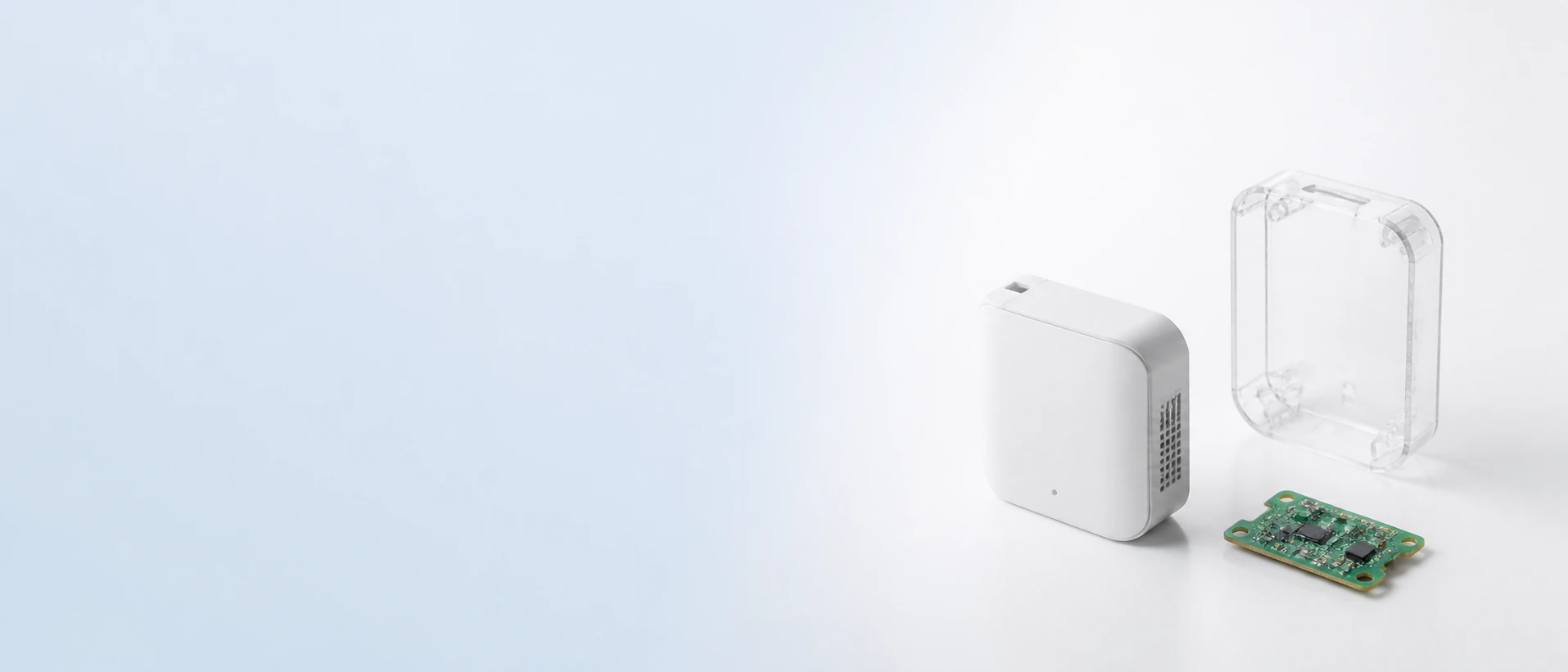
Your Vision, Our Engineering
Three decades of OEM/ODM manufacturing, ISO-certified quality, and global regulatory support: one factory takes you from concept to mass production.
Why Choose Gooten
30+ Years Experience
Since 1996, a proven track record partnering with global brands across consumer electronics, consumer electronic medical devices, and luxury accessories.
ISO Dual Certified
ISO 9001 + ISO 13485 certified. Full compliance for consumer product and consumer electronic medical device manufacturing with rigorous quality assurance.
End-to-End Capability
From concept design to mass production under one roof. In-house ME, EE, mold, PCB/PCBA, and assembly teams.
Global Compliance
CE, FCC, FDA documentation and testing support. We handle regulatory pathways for the US, EU, Japan, and emerging markets.
Three Things We Do Exceptionally Well
Consumer Electronic Medical Device OEM
Consumer electronic medical device contract manufacturing under an ISO 13485 quality system, with dedicated assembly lines and documentation support for FDA-cleared home-use devices.
Explore medical manufacturing → Medical Device OEM Project ReviewHealth & Wellness Appliances ODM
In-house R&D for air purification, water filtration, UV-C sanitizing, and baby-care devices, engineered and private-label ready for your brand.
Explore appliance ODM → Health Appliance ODM Project ReviewConsumer Electronics
PCB/PCBA design, SMT assembly, battery and power management: full electronics integration under one roof.
Explore electronics manufacturing → Consumer Electronics OEM Project ReviewThe 5-Phase OEM/ODM Process
← Swipe to see all steps
NDA before any technical discussion, then Why-What-When-Where positioning analysis: market research, competitive positioning, and user-needs assessment. Initial response within two business days.
2D/3D simulation, industrial design, and mechanical and electrical engineering development, shaped into a concrete proposal and project plan.
Prototype iteration and validation with design-for-manufacturing review. Injection, blow, and roto molding feasibility; tooling cost and lead-time analysis.
Pilot run under the ISO 13485 quality system. White-label, co-branded, or fully custom packaging; regulatory labeling and documentation support for your target markets.
ISO-certified QC at every stage (pre-production, in-process, and final inspection, with third-party testing when required), through global delivery.
Technology Expertise
UV-C Modules & Germicidal Systems
UV-C light in the 200–280 nm germicidal range (typically 254 nm) disrupts the DNA and RNA of bacteria, viruses, and mold so they can no longer reproduce. Disinfection is chemical-free and leaves no residue; effectiveness depends on the delivered dose, which is irradiation intensity multiplied by exposure time. Product design therefore centers on lamp or LED selection, reflector geometry for even coverage, and safety interlocks that cut exposure the moment a chamber opens.
UV-C sanitizing cleaner series and UV sterilizer boxes.
Ultrasonic Transducers (40 kHz)
A piezoelectric transducer converts electrical signals into high-frequency vibration. In liquid, the 40 kHz sound waves create microscopic bubbles that form and collapse millions of times per second, a process called cavitation. The collapsing bubbles gently scrub dirt and oils out of crevices that brushes cannot reach. 40 kHz is the sweet spot for consumer devices: strong enough to clean thoroughly, gentle enough for jewelry, eyeglasses, and precision parts.
Ultrasonic cleaner series and salon ultrasonic gel applicators.
Ionizer & HEPA Filtration Systems
A HEPA filter captures at least 99.97% of 0.3-micron particles as air is forced through its dense fiber web by interception, impaction, and diffusion. A negative-ion generator complements the filter by charging airborne particles so they cluster together and settle or are captured more easily. System performance comes from matching fan airflow, filter grade, and ionizer output to the target room size, expressed as the clean-air delivery rate (CADR).
Home air purifier series, developed and mass-produced.
PCB/PCBA Design & SMT Assembly
A product’s electronics start as a circuit schematic, then a board layout optimized for manufacturability (DFM). In surface-mount technology (SMT), solder paste is printed onto the bare board, components are placed by high-speed machines, and a reflow oven melts the paste into permanent joints. Automated optical inspection (AOI) and electrical testing then verify every board before it enters final assembly.
The backbone of every electronics line: laser control boards, charging modules, full-board assembly.
Battery & Power Management
Portable devices pair a lithium battery with a battery-management circuit that protects against over-charge, over-discharge, over-current, and abnormal temperature. Charging circuitry negotiates power over USB, while DC-DC converters feed each subsystem a stable voltage. Good power design balances runtime, charging speed, and battery lifespan with the transport and safety requirements that apply to lithium cells.
True-wireless watch winders, USB-charged purifiers, and portable power modules.
Laser Modules (Medical Grade)
Home-use therapeutic devices apply low-level laser light, typically red wavelengths around 650 nm, to deliver photobiomodulation: light energy absorbed by cells stimulates their metabolic activity without heating or damaging tissue. Safe, effective products depend on tight control of wavelength, output power, and beam distribution, plus laser-safety classification so devices remain eye-safe in everyday home use.
Home-use laser hair-growth devices built for international brands across four product generations.
Mini Motors for Portable Devices
Compact geared DC motors trade off torque, speed, noise, and lifespan. In a watch winder, the motor must rotate a weighted watch smoothly through programmed turns per day, quietly enough for a bedroom, reliably for years; that drives the gearbox choice, speed control, and vibration-isolating mounts. The same platform scales to massage modules, where an eccentric weight on the shaft converts rotation into vibration.
The Jebely watch winder line (Japanese motor platform) and vibration massage modules.
Consumer Electronics Integration
Turning a concept into a manufacturable device means co-designing mechanics, electronics, and firmware as one system: fitting boards, batteries, and modules into the industrial design, managing heat and electromagnetic interference, and designing for assembly from the first prototype. A structured new-product introduction, from engineering samples through pilot runs to mass production, catches issues while they are still cheap to fix.
Turnkey builds from cleaners to watch winders and wearable devices.
Frequently Asked Questions
Where is your factory located?
We design and manufacture in Taichung, Taiwan, with production, QA and R&D under one roof.
What certifications do you hold?
ISO 13485:2016 and ISO 9001:2015, with CE, FCC, RoHS, and PSE compliance. Certificates are verifiable; scans available on request.
Do you sign NDAs?
Yes, an NDA is available before any technical discussion.
How fast do you respond to an RFQ?
An engineer, not a sales bot, gives you an initial response within two business days, with design-for-manufacturing feedback alongside every quotation.
Do you offer both OEM and ODM?
Yes: from build-to-print OEM to full ODM with in-house R&D, industrial design, engineering, and certification support.
Can we visit the factory?
Absolutely. We host brand teams from the US, Europe, and Japan. Book a factory tour from any page.
Which markets do you ship to, and at what scale?
We've shipped more than 1,000,000 units cumulatively to customers in over 50 countries, including brands in the US, Europe, and Japan.
What does your five-phase process look like?
Feasibility Review & NDA → Engineering Proposal & Project Planning → Prototype, DFM & Validation → Pilot Production, Packaging & Certification → Mass Production & Delivery
What products and technologies can you build?
In-house R&D across mechanics and electronics, PCB/PCBA design and SMT, battery and power management, UV-C modules, 40 kHz ultrasonic transducers, HEPA and negative-ion systems, medical-grade laser modules, and micro-motors.
What certification support do you provide, and where are its limits?
We have compliance experience with CE, FCC, RoHS, and PSE, and we provide documentation and testing support for FDA submissions. We support your filing; we don't submit or register on your behalf.
How long do your customer relationships last?
Our longest active customer, a US hair-growth device leader, has built with us since 2008 across four product generations of home-use laser hair-growth systems, 18-plus years and counting.
What is your MOQ, and how is pricing structured?
Both are quoted per project rather than published. MOQ follows changeover economics and the minimum lot sizes your components carry; pricing follows tooling, materials, and certification scope. Tell us the product type, target market, and expected annual volume, and the first reply already carries real numbers instead of a range that would not apply to you.
Are there products you do not take on?
Yes. We do not build food-contact products or implantable medical devices. Saying so up front saves both sides a round of emails; for everything else, the technology list above is the honest scope of what we run in-house.
Related reading
OEM vs ODM: MOQ, Tooling, IP and Timeline
OEM vs ODM in plain terms: how MOQ, tooling ownership, documentation, IP and timeline actually differ, plus a decision tree and the hybrid model.
Read more →ISO 13485 Contract Manufacturer: How to Verify One
What an ISO 13485 contract manufacturer does: traceability, DHR, design controls, and how to verify one when sourcing from Taiwan. Talk to our engineers.
Read more →Tooling Cost and MOQ Explained for OEM Projects
Why tooling cost and MOQ land where they do in OEM projects: cavity count, mold steel, changeover economics, and eight questions to ask about any quote.
Read more →DFX Risk Review Before Cutting Tooling
How a 33-item DFX risk review with red, yellow, and green ratings catches compliance, safety, and supply chain risks before tooling: a UV-C product case.
Read more →Developing Products With AI: The Factory Handoff
AI compresses the front end of product development. Tooling, certification and component lead times do not move. What that asymmetry does to the handoff.
Read more →Consumer Electronics ODM: How a Project Runs
The five stages of a consumer electronics ODM build, what each side owes at each one, and the three decisions this category forces earlier than most.
Read more →Cyber Resilience Act: What It Asks of Hardware
The CRA's first deadline lands 11 September 2026 and reaches products you shipped years ago. What the reporting clock, support period and SBOM ask of hardware.
Read more →Taiwan vs China Sourcing: Tariffs and Origin
Tariff rates move constantly. What decides them does not: HTS code, country of origin, and which layers attach. Why assembly location is not origin.
Read more →Vetting a Manufacturer for Confidential Work
An NDA is the floor, not the answer. What to ask about file access, subcontracting, tooling custody and jurisdiction before handing over a design.
Read more →What to Put in an OEM Inquiry
What separates a two-day answer from a month of back-and-forth is usually the first message. Five things worth including, and what to do about the blanks.
Read more →Come See the Factory Yourself
The fastest way to evaluate a manufacturing partner is to walk the floor. We host brand teams from the US, Europe, and Japan. Book a tour, or start with a quote.
Book a Factory TourSend an Inquiry
Tell us what you're building. We will get back to you with an initial response within two business days.
- Initial response within two business days
- NDA available before any technical discussion
- Design-for-manufacturing feedback with every quotation
- English-speaking engineering team